
Flood cleanup in Conroe, TX
Outside water plays by different insurance rules than a burst pipe, and it doesn't stop at the waterline you can see.
Call For Help(936) 274-144624/7 emergency line. Free estimates from local pros.
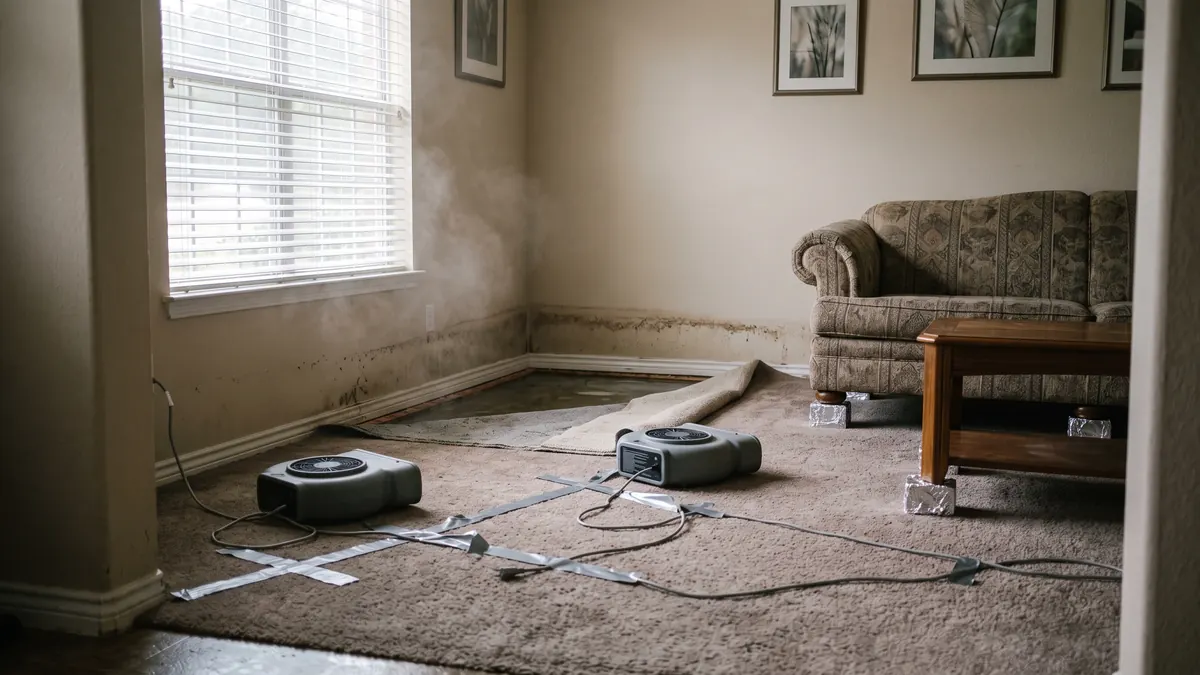
When the West Fork San Jacinto River leaves its banks, the water reaching your house is a different problem than a burst pipe ever was. It’s dirty, it’s usually excluded from your regular policy, and it doesn’t stop at the line you can see on the wall. Here’s what changes once the water came from outside instead of from inside your own plumbing.
Why your homeowners policy stops at the flood line
A standard Texas homeowners policy pays for water that gets loose inside your house: a burst pipe, a failed hose, a supply line that lets go. Water that rises up outside and crosses your yard into your house reads as a different category to an insurer, and it’s usually not covered under that same policy. Flood coverage comes from a separate policy, either the National Flood Insurance Program or a private carrier, and a lot of Conroe homeowners have never had a reason to buy one before now.
This water counts as contaminated
Water that arrives from outside almost always lands in what restoration pros call category 3, the label for water carrying real contamination. The water damage categories guide gets into what that number means for a job. If the water crossed a backed-up sewer line on its way into your house, the sewage cleanup page is the deeper read on what that adds. Here, the short version is enough: treat the water as dirty and handle it that way from the first step.
The corridors that flood here
Conroe sits inside the West Fork San Jacinto River watershed, and three waterways carry the flood risk the city and FEMA have documented for decades: the West Fork itself, White Oak Creek, and North Fork Stewarts Creek. During Hurricane Harvey in 2017, Lake Conroe rose to a record 206.2 feet above sea level, and the dam’s controlled release peaked near 79,000 cubic feet per second, according to Community Impact’s reporting on the city’s recovery. That combination is why river water can reach homes well outside a creek’s normal banks.
Not the first time, and it won’t be the last
Conroe has seen this again more recently. Heavy rain in the spring of 2024 pushed the West Fork out of its banks a second time, and some of the same neighborhoods that flooded during Harvey went under again. A local river doesn’t need a hurricane to cause real damage here, and that’s worth remembering the next time a spring storm stalls over Montgomery County.
What makes it through the water
Hard, sealed surfaces usually make it through fine: tile, sealed concrete, most metal fixtures. Anything soft enough to soak up water is a harder case. Wet carpet, the pad underneath it, and drywall that sat in contaminated water typically get cut out rather than cleaned, because there’s no reliable way to dry contamination out of a porous material. Someone walking the site can tell you which category each item falls into once they see how long the water sat.
Check your flood zone before the next storm
You don’t have to guess whether your house sits in a flood-prone spot. The City of Conroe’s Engineering Department offers free flood-zone determinations for properties inside city limits, and Montgomery County keeps its own flood-hazard map online for a broader look. Knowing before a storm beats finding out during one.
River water plays by different rules
If the water that reached your house came from outside, a river out of its banks rather than a pipe inside a wall, the insurance conversation starts differently, and so does the cleanup. Call us and lay out what happened: where the water came from, how high it got, and what’s already ruined. We answer 24/7, and getting a local crew looking at the damage sooner tends to make the whole claim easier to sort out. For the coverage side of any of this, the homeowners insurance guide gets into the details.
Common questions
Why doesn't my homeowners policy pay for this?
Standard homeowners policies generally exclude damage from rising water, the kind that comes from outside rather than from a pipe inside your house. Flood coverage is a separate policy, and plenty of Conroe homeowners have never carried one. That's the gap that catches people off guard once the water is gone.
How is floodwater different from water from a burst pipe?
Floodwater picks up dirt, yard chemicals, and often sewage on its way to your house, so it's treated as contaminated from the start. A burst pipe is usually clean water. That single difference changes what gets saved and what gets thrown out.
Can carpet or furniture survive a flood?
Rarely, once floodwater has actually soaked in. Soft, porous material holds contamination that drying can't remove, so most of it gets pulled out instead of cleaned. Hard, sealed surfaces have a much better chance.
How do I find out if my house sits in a flood zone?
The City of Conroe's Engineering Department offers free flood-zone determinations for properties inside city limits, and FEMA's map service covers any Texas address. Checking before the next storm beats guessing during one.
Related pages
Appliance Leak Cleanup
The tank is a plumber's job. The floor underneath it is a different problem entirely.
Learn more →Burst Pipe Cleanup
A burst pipe is loud, fast, and the kind of loss most Texas policies are actually built to pay for.
Learn more →Ceiling Water Damage
The color, edge, and spread of a ceiling stain tell you more about the source than a guess ever will.
Learn more →Commercial Water Damage
A flooded stockroom isn't a flooded living room. Inventory, leases, and a reopening date all ride on it.
Learn more →Talk to a local pro now
We answer 24/7. One call gets a Conroe crew moving on your water damage, with a free estimate and help with your insurance claim.
Call For Help(936) 274-1446Free estimates. No obligation to hire.